If you've ever shopped for a dehumidifier and ended up down a rabbit hole of pint ratings, CFM specs, and units built like a tank, you've probably brushed up against the residential versus commercial divide without realizing it.
The difference isn't just price. It's capacity, durability, airflow, and the kind of moisture problem each unit is actually built to handle. A residential dehumidifier and a commercial one are solving the same basic problem in very different contexts, and putting the wrong one in the wrong space usually means either paying for more than you need or watching an undersized unit struggle to keep up.
Here's how to tell them apart and figure out which one your situation actually calls for.

Quick Answer: What Is the Difference Between a Residential and Commercial Dehumidifier?
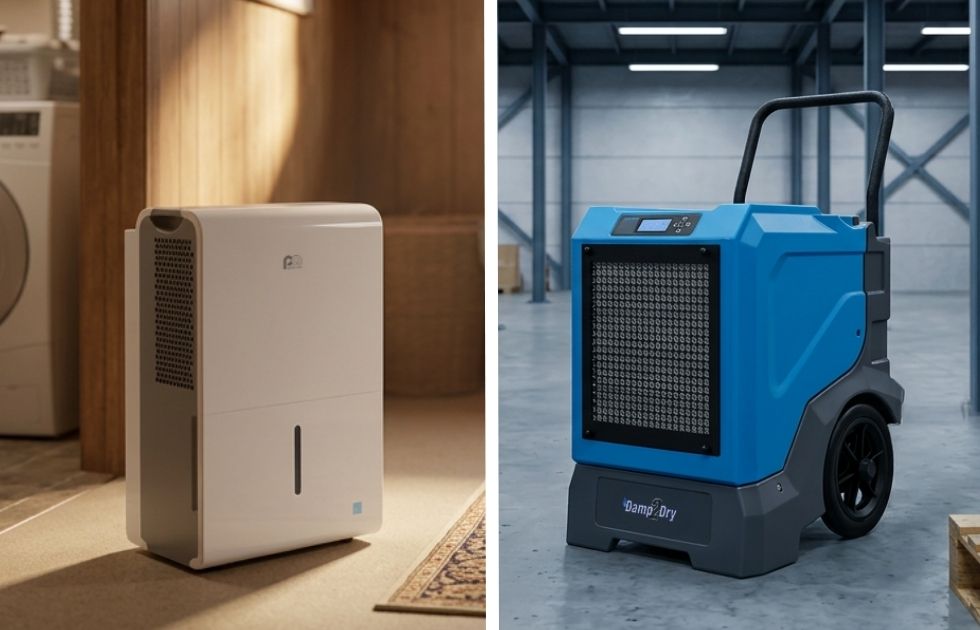
Residential dehumidifiers are designed for home use, typically handling spaces up to around 2,500 square feet with moderate moisture levels. They're sized for bedrooms, basements, and living spaces, run quietly, and drain into a collection tank or standard drain. Commercial dehumidifiers are built for larger spaces, higher moisture loads, and continuous heavy-duty operation. They move significantly more air, remove more moisture per day, and are built to run hard in demanding environments like job sites, rental properties, warehouses, and water damage restoration situations.
What Residential Dehumidifiers Are Designed For
A residential dehumidifier is built around the moisture problems most homeowners actually deal with. A basement that runs damp in summer. A bedroom that feels clammy. A crawl space that needs consistent moisture control. Spaces that are enclosed, moderately sized, and dealing with ambient humidity rather than active water intrusion or extreme moisture loads.
Residential units are rated in pints per day, typically ranging from around 20 pints on the smaller end to 70 or so pints for larger whole-basement units. They're designed to maintain a target humidity level in a defined space, run quietly enough not to be disruptive, and fit into a home environment without looking like they were borrowed from a job site.
What residential dehumidifiers handle well:
- Basements and crawl spaces with chronic ambient humidity
- Bedrooms, living rooms, and finished spaces that feel clammy
- Seasonal moisture control in homes located in humid climates
- Spaces up to around 2,500 square feet depending on capacity and conditions
What they're not built for:
- Spaces with active water intrusion or flood recovery situations
- Large open commercial or industrial environments
- Continuous heavy-duty operation in demanding conditions
- Spaces where airflow and moisture removal need to happen fast
For most homeowners dealing with chronic basement humidity, a slightly damp spare room, or a living space that never quite feels comfortable in summer, a residential unit is the right starting point. The question of whether you need to step up to a commercial unit usually comes down to the size of the space, the severity of the moisture problem, and how hard the unit needs to work on a daily basis.

What Commercial Dehumidifiers Are Designed For
A commercial dehumidifier is built around a different set of problems entirely. Larger spaces, higher moisture loads, and conditions where a residential unit would either fall short or burn out trying to keep up.
Commercial units are built for continuous heavy-duty operation. They move significantly more air than residential units, remove substantially more moisture per day, and are designed to hold up in demanding environments where the moisture problem isn't just ambient humidity but active water, high occupancy, or industrial-level conditions.
What commercial dehumidifiers handle well:
- Large open spaces like warehouses, gyms, and multi-room facilities
- Rental properties and multi-unit buildings where moisture control spans multiple areas
- Water damage restoration and flood recovery situations where moisture needs to be removed quickly and aggressively
- Commercial kitchens, laundry facilities, and other high-moisture production environments
- Job sites and construction environments where concrete, drywall, and building materials need to dry before work can continue
- Indoor pools, spas, and facilities with consistently high moisture output
What sets them apart from residential units:
- Higher pint-per-day capacity, often ranging from 100 pints to several hundred pints per day depending on the unit
- Higher CFM ratings, meaning they move more air through the system per minute and cover larger spaces more effectively
- More durable construction built to handle continuous operation in rough environments
- Larger physical footprint and industrial-grade components designed for longevity under heavy use
- Often include features like integrated pumps, hot air exhaust hoses, and more robust controls suited for professional applications

Key Differences Between Residential and Commercial Dehumidifiers
The distinction between residential and commercial units comes down to five things: capacity, airflow, durability, portability, and operating conditions. Understanding where each one lands on these factors makes the choice a lot clearer.
Capacity
Residential units typically remove between 20 and 70 pints of moisture per day. Commercial units start where residential units leave off and scale significantly higher, often handling 100 to several hundred pints per day depending on the application.
Airflow
CFM, or cubic feet per minute, measures how much air a unit pulls through its system. Residential units move enough air to handle a defined home space effectively. Commercial units move significantly more air per minute, which matters in large open environments where moisture is distributed across a much bigger volume and needs to be captured efficiently.
Durability and build
Residential units are built for home environments. Consistent use, moderate conditions, reasonable run times. Commercial units are engineered for continuous heavy-duty operation in demanding conditions. The components, housing, and internal systems are built to a different standard because the operating demands are fundamentally different.
Portability and form factor
Residential units are designed to fit into a home environment. They're relatively compact, move easily on casters or handles, and store out of the way when not needed. Commercial units are larger, heavier, and built for deployment rather than discreet placement. Many include heavy-duty wheels and handles designed for moving across job sites or between facility spaces rather than tucking into a basement corner.
Operating conditions
Residential units are designed to operate within the temperature and humidity ranges typical of a home interior. Commercial units are often rated for operation in more extreme conditions, including lower temperatures, higher humidity levels, and environments that a residential unit simply wasn't designed to handle.
Residential vs Commercial Dehumidifiers: A Side by Side Comparison
| Residential Dehumidifier | Commercial Dehumidifier | |
|---|---|---|
| Capacity | 20–70 pints per day | 100–300+ pints per day |
| Best for | Homes, basements, crawl spaces | Warehouses, job sites, multi-unit properties, restoration |
| Airflow | Moderate CFM for defined home spaces | High CFM for large open environments |
| Build | Home-grade components, quieter operation | Industrial-grade, built for continuous heavy use |
| Portability | Compact, easy to move within a home | Larger, heavy-duty casters for job site deployment |
| Operating conditions | Standard home temperature and humidity ranges | Rated for extreme humidity and lower temperatures |
| Drain options | Collection tank or gravity drain hose | Integrated pump, larger drain connections |
| Noise level | Designed for quiet home operation | Louder, prioritizes performance over noise |
| Typical use case | Chronic ambient humidity in home spaces | Active moisture removal, large spaces, restoration |
Which One Do You Actually Need?
The honest answer for most people reading this is a residential unit. If you're a homeowner dealing with a damp basement, a crawl space that runs humid, or a living space that never quite feels dry, a properly sized residential dehumidifier handles that well. The capacity range available in residential units covers the vast majority of home moisture problems without needing to step up to commercial equipment.
The question shifts when the space, the moisture load, or the operating demands push beyond what a residential unit is built for.
You probably need a residential unit if:
- You're dealing with ambient humidity in a home basement, crawl space, or living area
- The space is under 2,500 square feet and doesn't have an active water intrusion problem
- You need quiet, consistent moisture control in a home environment
- The moisture problem is chronic but moderate, the kind that builds up over time rather than arriving all at once
You probably need a commercial unit if:
- The space is large, open, and exceeds what a residential unit can cover effectively
- You're managing moisture across a rental property, multi-unit building, or commercial facility
- You're dealing with water damage, flood recovery, or a situation where moisture needs to be removed quickly and aggressively
- The unit needs to run continuously in demanding conditions that would wear out a residential unit prematurely
- You're a contractor, property manager, or facility operator where equipment durability and capacity directly affect your ability to do the job
If you're on the fence, the deciding factors are usually space size, moisture severity, and how hard the unit needs to work on a daily basis. A residential unit pushed beyond its design limits runs constantly, wears out faster, and never quite gets the space where it needs to be. A commercial unit in a space that doesn't need it is simply more than the situation calls for.
When a Residential Unit Isn't Enough
There are situations where the signs point clearly toward commercial equipment, even for someone who doesn't think of themselves as a commercial buyer.
- The space is larger than a typical home basement. A detached garage, a large workshop, a barn conversion, or a commercial space attached to a home can exceed what residential units handle efficiently. Square footage alone doesn't always tell the whole story, but when a space starts running well above 2,500 square feet with consistent moisture problems, commercial capacity starts making more sense.
- The moisture problem arrived suddenly and needs to go away fast. Ambient humidity builds gradually and responds to gradual solutions. A burst pipe, a flooded basement, or significant water intrusion is a different problem entirely. Restoration situations call for commercial-grade moisture removal because the goal isn't maintenance, it's recovery. Getting a space dry quickly requires moving a lot of air and pulling a lot of moisture out in a short window.
- The unit needs to run in conditions a residential unit wasn't designed for. Very low temperatures, extremely high humidity levels, or outdoor-adjacent environments push beyond the operating range of most residential units. Commercial units are rated for these conditions because the applications that need them regularly involve them.
- You're managing the problem across multiple spaces or units. A property manager dealing with moisture issues across several apartments, a contractor handling multiple restoration jobs, or a facility operator managing humidity in a large building isn't dealing with a single-room problem. Commercial equipment is built for deployment at scale, which is a different use case than keeping one basement comfortable.
If any of these situations sound familiar, the step up to commercial equipment is worth taking seriously. The right unit for the actual problem is always more efficient and more effective than pushing a residential unit past what it was designed to do.
The Right Tool for the Right Moisture Problem
A dehumidifier is only as useful as it is matched to the job. Too small and it runs constantly without making a dent. The distinction between residential and commercial isn't about prestige. It's about putting the right capacity and the right build quality where the moisture problem actually lives.
Damp basement or chronically humid living space? A residential dehumidifier handles that. Large facility, water damage recovery, or moisture control across a commercial property? That's what commercial dehumidifiers are built for. Browse both categories to find the right fit for your situation.