
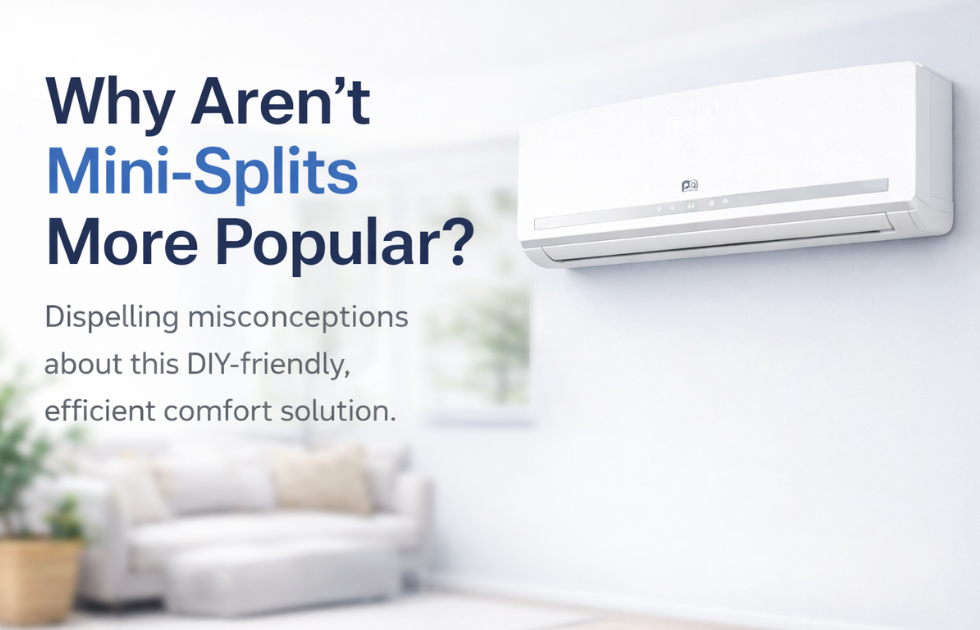
Mini-splits are known for energy efficiency, flexible installation, and zoned comfort, so it’s fair to wonder why they still feel like a niche option in the U.S. Many homeowners have heard of them, but fewer have actually considered one for their own space.
The truth is, mini-splits aren’t unpopular because they don’t work. They’re often overlooked due to long-standing habits, outdated assumptions, and a few persistent myths around installation, appearance, and cost. As more people look for alternatives to traditional HVAC, especially DIY-friendly options, those perceptions are starting to change.
Before writing off mini-splits as a “non-traditional” choice, it’s worth understanding what’s really held them back and whether any of that should matter for your home.
Reason #1: Central HVAC Became the Default in the U.S.
Mini-splits aren’t unpopular because they’re ineffective. They’re less common largely because central HVAC became the standard first.
After World War II, most new homes in the U.S. were built with ductwork already planned in. Central heating and cooling systems fit neatly into that model, and over time they became the “normal” solution homeowners expected. Anything outside of that, including mini-splits, was often viewed as an alternative rather than a primary option.
In many other parts of the world, where homes were built without ductwork, mini-splits became the default instead. The difference comes down to building history, not performance.
Bottom line: Mini-splits didn’t lose out because they were worse. They simply arrived later to a market already shaped by central air.
Reason #2: Outdated Perceptions About Appearance and Performance
Early systems were often bulky, limited in design, and unfamiliar to homeowners used to vents and registers. That led to assumptions that mini-splits were awkward, underpowered, or only suitable for small spaces. Those perceptions have stuck around longer than they should.
Modern mini-splits are quieter, more efficient, and far more capable than their early counterparts. They can comfortably handle spaces where window or portable units struggle, and they do it without the noise, drafts, or inefficiency those options bring.
Reality check: Most concerns about performance or aesthetics are based on outdated information, not how current systems actually operate.
Reason #3: Installation Myths Still Get in the Way
For a lot of homeowners, mini-splits sound complicated before the conversation even starts.
There’s a common assumption that every mini-split installation requires a full professional install. While that’s true for some traditional systems, it’s not the full picture anymore.
Today, there are mini-split systems specifically designed to be DIY-friendly. These models use pre-charged line sets and simplified mechanical connections that eliminate the need for vacuum pumps or refrigerant work. That makes installation far more approachable for confident homeowners, often with help from an electrician for the final electrical connection.
The challenge is that many people don’t realize there’s a difference between standard mini-splits and true DIY systems. Without that distinction, mini-splits get written off as too complex or too expensive to install.
What to know: Not all mini-splits are DIY, but true DIY systems are intentionally built to make installation simpler, faster, and more affordable.
Reason #4: People Overestimate What They Need
Mini-splits are often misunderstood because people assume they have to replace an entire HVAC system to be worthwhile.
Some homeowners think every room needs its own indoor unit, or that a mini-split only makes sense as a whole-home solution. That assumption can make the system feel oversized, overly expensive, or unnecessary.
In reality, mini-splits work best when they’re used strategically. They shine in spaces that are hard to heat or cool with central air, like additions, finished garages, bonus rooms, or areas with inconsistent comfort. In those cases, a single-zone system can deliver targeted comfort more efficiently than extending ductwork or relying on window units.
Key takeaway: Mini-splits don’t have to do everything to be worth it. Solving one comfort problem well is often enough to justify the upgrade.
So…Should You Care That Mini-Splits Aren’t “Popular”?
One of the biggest lingering concerns around mini-splits is how they affect home value. Some homeowners worry that anything outside of traditional central HVAC could hurt resale, but that idea is largely outdated.
Today’s buyers are far more familiar with energy-efficient upgrades, and many see mini-splits as a practical improvement, especially in homes without ductwork. Compared to window or portable units, a properly installed mini-split is often viewed as a cleaner, more permanent solution.
In older homes, additions, or spaces with uneven heating and cooling, mini-splits can actually improve buyer appeal by solving comfort issues that central systems struggle with. What matters most is that the system is appropriately sized, neatly installed, and clearly adds value to the space.
The reality: Mini-splits are judged on how well they improve comfort and efficiency, not on whether they’re the most common system in the neighborhood.
The Bottom Line: Mini-Splits Don’t Need to Be Popular to Be Practical
Mini-splits aren’t less common because they fall short. They’ve simply been slower to catch on in a market long shaped by central HVAC and a few persistent misconceptions. As homeowners look for more flexible, efficient, and cost-conscious ways to solve comfort problems, mini-splits are starting to make a lot more sense.
Whether you’re upgrading an older home, adding comfort to a specific space, or looking to avoid invasive ductwork, mini-splits offer a practical alternative that performs well when used intentionally. And with modern DIY-friendly options, the barrier to installation is lower than many people realize.
Curious whether a mini-split makes sense for your space? Our Mini-Split Buying Guide is a great place to start, and when you’re ready, our DIY Quick Connect mini-splits make upgrading easier than you might expect.