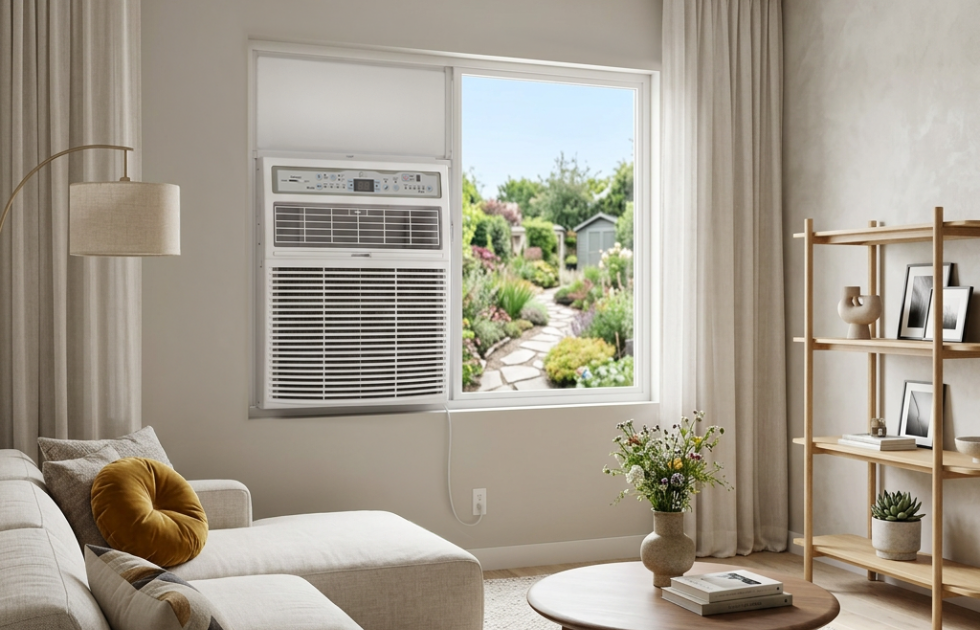
Most window air conditioners are designed for double-hung windows. The kind that slide up and down, have a flat sill, and give you a nice rectangular opening to work with.
If that's not what you have, you've probably already run into this problem every summer. You search for a window AC, find a dozen options, and then realize none of them fit your window type at all.
Slider windows open side to side. Casement windows swing outward on a hinge. Neither one plays well with a standard window AC unit, and trying to make it work usually ends in a unit that doesn't seal, doesn't fit, or falls out of the opening entirely.
The good news is there are options made for exactly this situation. The key is knowing which window type you have and which AC solution actually fits it.

Quick Answer: What Kind of AC Works for Slider and Casement Windows?
For slider windows, a vertical window air conditioner designed for horizontal openings is your best fit. Some standard units also work with the right bracket kit. For casement windows, a portable air conditioner is usually the most practical solution since casement windows don't provide a flat sill or standard frame to mount a unit. If neither option works well for your space, a DIY mini-split system avoids the window entirely.
What Makes Slider and Casement Windows Different from Standard Windows
Standard double-hung windows open vertically and leave a wide, flat, roughly rectangular opening. That's exactly what most window AC units are designed around.
Slider and casement windows break that mold in two different ways.
Slider windows open horizontally, sliding left or right along a track. The opening is taller than it is wide, which is the opposite of what a standard window AC needs. Most units are built wide and short. A tall, narrow opening leaves you with gaps, poor sealing, and a unit that has no real support.
Casement windows are hinged on one side and crank outward. There's no flat sill to rest a unit on, no frame to extend panels into, and the window itself swings into the space where an AC would need to sit. A standard unit simply has nowhere to go.
Both window types are common in newer construction, mid-century homes, apartments, and commercial buildings, which is exactly why this question comes up so often.
What Works Best for Slider Windows
Slider windows have one thing going for them: they do open, and they do leave a usable opening. The challenge is that the opening is vertical instead of horizontal, so you need a unit designed to work with that shape.
Vertical or slider-specific window AC units are built for exactly this. They install in the tall, narrow opening a slider window creates, include top and side panels that fill the gaps, and are designed to seal and support the way a standard unit would in a double-hung window. They're also typically taller and narrower than standard window ACs to fit in this type of opening. If you have a slider window and want a dedicated window unit, this is the right product category to look for.
- Measure your window opening height and width before shopping. Slider window AC units have specific dimension requirements just like standard units do.
- Look for a unit that includes a mounting bracket, or purchase a universal bracket to help distribute the weight on your window sill.
For most slider window situations, the Perfect Aire 4PASC10000 hits the sweet spot in sizing and handles rooms up to around 450 square feet comfortably.

What Works Best for Casement Windows
Casement windows are the trickier situation. Because they hinge outward, there's no flat sill, no standard frame opening, and no easy way to support or seal a window unit. Most window ACs, including slider-specific ones, won't work here without some extra effort.
You have two real options depending on how handy you are and how permanent you want the solution to be.
The straightforward solution: a portable air conditioner
A portable AC sits on the floor inside the room and vents hot air outside through a hose. That hose connects to a slim window vent panel that fits into a partially open window. For casement windows, you only need to crack the window open slightly to run the hose through, which means the hinge mechanism isn't a problem.
It's not quite as efficient as a mounted window unit, but it works, it doesn't require permanent installation, and it doesn't ask your window to do something it wasn't built for.
- Measure the opening your window creates when partially cranked and confirm the vent panel fits.
- Seal any gaps around the panel. Hot air coming back in will work against you.
- Size up slightly on BTUs since portable ACs are less efficient than window-mounted units.
The advanced option: remove the pane and install a window unit
If you want the performance of a dedicated window AC and you're comfortable with a more involved project, it is possible to install a slider or casement window AC unit in a casement opening. The catch is that it potentially requires removing the window pane and hardware, including the crank mechanism, to create a clean opening the unit can sit in.
Done right, the unit mounts securely, seals well, and performs the way a standard window installation would. Done wrong, you've got air gaps, a unit that isn't properly supported, and a window that no longer functions.
This is a reasonable path for a confident DIYer who doesn't mind a permanent modification, or for someone willing to bring in a professional installer to handle the window prep. It's not a weekend impulse project, but it's not out of reach either.
If you go this route, measure carefully, make sure the modified opening matches the unit's required dimensions, and plan for proper sealing and support before the unit goes in.
What If None of the Window AC Options Work for Your Space?
Sometimes the window situation isn't the only problem. Maybe you're in a room without a usable window at all. Maybe the window is too small, too awkwardly placed, or in a location where any kind of window unit creates a security or weather concern. Maybe you've looked at every option and nothing feels right.
That's where a DIY mini-split system becomes worth a serious look.
A mini-split doesn't use your windows at all. The indoor unit mounts on the wall, the outdoor unit sits outside, and the two connect through a small hole drilled through the wall. No window opening required, no vent hose, no panels to seal around.
True DIY mini-split systems use pre-charged line sets and quick-connect fittings, which means no refrigerant handling, no vacuum pump, and no specialized HVAC tools. Most homeowners can complete the installation in a day using basic household tools.
It's a bigger upfront project than dropping a window unit in place, but it's also a permanent, efficient solution that works regardless of what kind of windows you have.

Slider vs Casement Windows: Best AC Options at a Glance
| Window Type | Best Option | Backup Option | Advanced Option |
|---|---|---|---|
| Double-hung (standard) | Standard window AC | Any window AC unit | Mini-split |
| Slider (opens side to side) | Slider/vertical window AC | Portable AC | Mini-split |
| Casement (hinges outward) | Portable AC | Slider AC with pane removal | Mini-split |
Find the Right Cooling Solution for Your Windows
Not every window plays by the rules, and not every AC is built to handle the exceptions.
If you have a slider window, a vertical window AC unit gives you a clean, efficient installation without the workarounds. If you're working with a casement window, a portable AC gets the job done without touching the window hardware. And if the window isn't an option at all, a DIY mini-split system sidesteps the problem entirely.
Browse our full selection of slider and casement window air conditioners, portable air conditioners, and DIY mini-split systems to find the right fit for your space.
Not sure which BTU size you need? Check out our BTU sizing guide to match the right unit to your room before you buy.